
Digital Marketing Basics for Beginners
Digital marketing has become one of the most important ways for businesses to reach customers. As more people use search engines, social media, websites, email, and mobile applications every day, businesses have new opportunities to promote their products and services online.
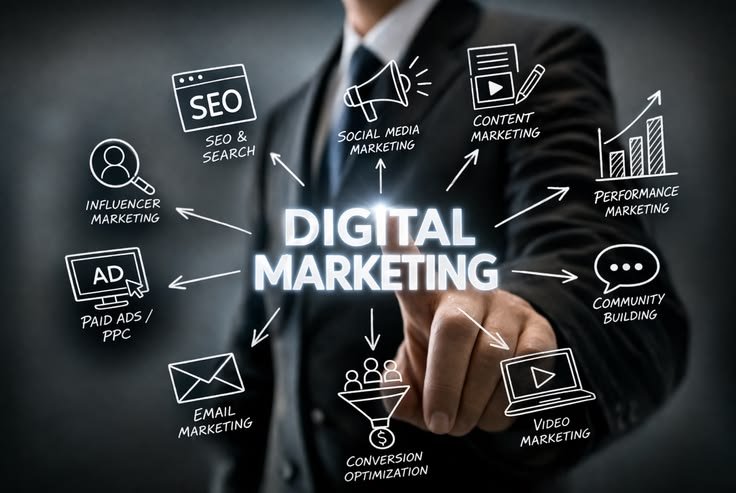
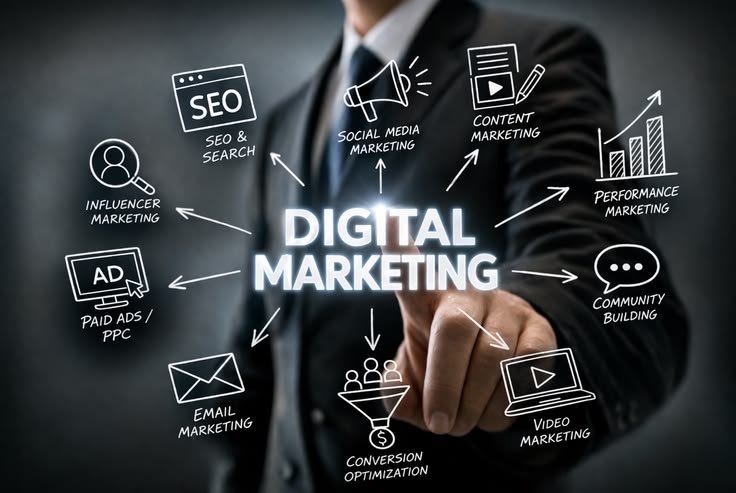
For beginners, digital marketing can seem complicated because it includes many different areas, such as search engine optimization, content marketing, social media marketing, email marketing, online advertising, and analytics. However, the basic principles are easier to understand when they are divided into simple parts.
This guide explains the fundamentals of digital marketing and how beginners can start understanding this important field.
What Is Digital Marketing?
Digital marketing is the use of digital channels and technologies to promote products, services, brands, or ideas.
Traditional marketing includes methods such as newspapers, television, radio, billboards, and printed advertisements. Digital marketing focuses on channels such as websites, search engines, social media, email, online video, and digital advertising platforms.
The main goal is not simply to get attention. Effective digital marketing aims to reach the right audience, provide useful information, build trust, generate leads or sales, and develop long-term customer relationships.
1. Start With a Clear Goal
Before creating advertisements or social-media posts, a business should decide what it wants to achieve.
Possible goals include:
- Increasing website traffic
- Generating leads
- Increasing online sales
- Building brand awareness
- Growing an email list
- Increasing customer engagement
- Improving customer retention
A clear goal makes it easier to choose the right marketing strategy and measure results.
For example, a business trying to increase online sales may focus on product pages, search visibility, paid advertising, email marketing, and conversion optimization.
2. Understand Your Target Audience
One of the most important principles of digital marketing is understanding the target audience.
A business should know who its potential customers are, what problems they have, what questions they ask, and what motivates them to make a purchase.
For example, a company selling professional software may target business owners and managers, while a company selling educational products may focus on students, parents, or teachers.
Understanding the audience helps businesses create more relevant messages.
3. Build a Professional Website
A website is often the foundation of a digital marketing strategy.
Social media can help people discover a business, but a website provides a central location where customers can learn about products, services, prices, contact information, and the company itself.
A good website should be easy to navigate, mobile-friendly, reasonably fast, secure, and simple to understand.
Each important page should have a clear purpose.
For example, a product page should explain what the product does, why it is useful, and how customers can purchase it.
4. Learn the Basics of SEO
Search Engine Optimization, or SEO, is the process of improving a website so that it can perform better in search-engine results.
Search engines attempt to provide users with useful and relevant results.
Businesses can improve their chances of appearing in search results by creating helpful content, organizing their websites properly, improving page performance, and making information easy for search engines and users to understand.
SEO is not simply about adding keywords repeatedly to a page. Modern SEO requires useful content, good website structure, strong user experience, and credibility.
5. Create Valuable Content
Content marketing is another major part of digital marketing.
Content can include:
- Blog articles
- Videos
- Guides
- Tutorials
- Infographics
- Podcasts
- Social-media posts
- Case studies
- Frequently asked questions
The purpose of content should be to provide value to the audience.
For example, a company selling gardening products could publish articles explaining how to grow vegetables, choose tools, or maintain plants.
Useful content can attract people who are searching for information and gradually introduce them to the business.
6. Use Social Media Strategically
Social media provides businesses with opportunities to communicate directly with customers.
Platforms can be useful for sharing content, introducing products, answering questions, building communities, and increasing brand awareness.
However, businesses do not need to use every social-media platform.
It is often better to choose platforms where the target audience is active and create content specifically suited to those platforms.
Consistency is generally more valuable than posting large amounts of content for a short period and then becoming inactive.
7. Understand Email Marketing
Email marketing allows businesses to communicate directly with people who have chosen to receive their messages.
Businesses can use email to share newsletters, product announcements, educational content, special offers, and updates.
A successful email strategy focuses on providing useful information rather than sending constant promotional messages.
Businesses should also obtain appropriate permission before sending marketing emails and provide clear ways for recipients to unsubscribe.
8. Learn About Online Advertising
Digital advertising allows businesses to pay for exposure on search engines, websites, social-media platforms, and other digital channels.
Unlike some traditional advertising methods, many digital advertising platforms provide detailed targeting and measurement options.
Businesses may be able to target audiences based on interests, search behavior, demographics, location, or other factors, depending on the platform and applicable rules.
Paid advertising can generate results quickly, but it can also become expensive if campaigns are poorly planned.
9. Understand the Customer Journey
Customers usually do not go directly from discovering a business to making a purchase.
They may first become aware of a company, then research the product, compare alternatives, read reviews, and finally make a decision.
This process is sometimes called the customer journey or marketing funnel.
Digital marketing should support customers at different stages.
For example, educational content can help people who are still researching, while product comparisons and testimonials can help people closer to making a purchase.
10. Build Trust
Trust is essential in digital marketing.
People are more likely to purchase from businesses that appear reliable and transparent.
Businesses can build trust by providing accurate information, clear pricing, useful customer support, authentic reviews, secure websites, and transparent policies.
Avoid misleading advertising or exaggerated claims.
A business may gain a short-term click through misleading content, but this can damage its reputation in the long term.
11. Use Analytics
Digital marketing provides access to a large amount of performance data.
Businesses can measure website visits, traffic sources, engagement, conversions, sales, email performance, advertising results, and other metrics.
Analytics can answer questions such as:
- Where are visitors coming from?
- Which pages receive the most attention?
- Which campaigns generate customers?
- Which content performs well?
- Where do visitors leave the website?
The goal is not to collect every possible metric. Instead, businesses should focus on information that helps them make better decisions.
12. Focus on Conversions
Getting website visitors is useful, but traffic alone does not guarantee business success.
A conversion occurs when a visitor completes a desired action.
This could include purchasing a product, filling out a contact form, subscribing to an email list, downloading a resource, or requesting a quote.
Businesses should make important actions easy to find.
Clear buttons, simple forms, useful product information, and straightforward navigation can improve the customer experience.
13. Mobile Marketing Matters
A large percentage of internet activity takes place on mobile devices.
Businesses should therefore ensure that websites, emails, advertisements, and other digital experiences work well on smartphones and tablets.
A website that is difficult to navigate on a small screen can cause visitors to leave.
Mobile-friendly design is therefore an important part of modern digital marketing.
14. Consistency Is Important
Digital marketing usually does not produce major results overnight.
Businesses often need to publish content consistently, test campaigns, improve their websites, and learn from performance data.
A company should avoid constantly changing its strategy simply because one post or campaign performs poorly.
Instead, review results over a reasonable period and make informed improvements.
15. Avoid Common Beginner Mistakes
Beginners often make several common mistakes.
One mistake is trying to use every marketing channel at once.
Another is focusing only on promotion instead of providing useful information.
Some businesses also ignore analytics and make decisions based entirely on assumptions.
Another common problem is expecting immediate results from SEO or content marketing.
A better approach is to start with a small number of channels, establish clear goals, measure performance, and gradually expand.
16. Learn and Adapt
Digital marketing changes frequently.
Search engines update their systems, social-media platforms introduce new features, advertising costs change, and consumer behavior evolves.
Successful marketers therefore need to keep learning.
The most important skill is not memorizing every platform feature. It is understanding fundamental marketing principles and being able to adapt them to changing technology.
Conclusion
Digital marketing provides businesses with powerful ways to reach customers, build relationships, and increase sales.
Beginners should start with the basics: define clear goals, understand the target audience, build a useful website, create valuable content, learn SEO, use social media strategically, understand email marketing, and measure results.
The most successful digital marketing strategies are not simply about getting as many clicks as possible. They focus on reaching the right people, providing genuine value, building trust, and helping customers make informed decisions.
With consistent effort, experimentation, and continuous learning, digital marketing can become a powerful tool for businesses of almost every size.