Common Email Marketing Mistakes to Avoid
Email marketing is one of the most effective ways for businesses to communicate with customers, nurture leads, promote products, and build long-term relationships. However, simply sending emails does not guarantee success.
Many businesses make avoidable mistakes that reduce engagement, increase unsubscribes, damage their sender reputation, or prevent campaigns from generating meaningful results. Some businesses send too many promotional messages, while others fail to understand their audience or provide enough value.
Understanding these common mistakes can help businesses create better email campaigns and develop stronger relationships with subscribers.
1. Sending Emails Without Proper Permission
One of the most important email marketing rules is to communicate with people who have appropriately agreed to receive marketing messages.
Adding random email addresses to a marketing list can create a poor experience for recipients and may violate applicable privacy or marketing requirements.
People should understand what they are subscribing to and what type of communication they can expect.
A transparent signup process can help establish trust from the beginning.
Businesses should also provide a clear and functional way for recipients to unsubscribe from marketing communications.
2. Buying Email Lists
Buying an email list may seem like an easy way to grow an audience quickly, but it is usually a poor long-term strategy.
Purchased lists can contain outdated addresses, irrelevant contacts, or people who never agreed to receive communication from your business.
This can result in:
- Low engagement
- High unsubscribe rates
- Spam complaints
- Poor sender reputation
- Deliverability problems
- Reduced campaign performance
Instead of purchasing contacts, businesses should build their own permission-based lists.
A smaller list containing genuinely interested subscribers can be much more valuable than thousands of unrelated addresses.
3. Not Understanding the Target Audience
Another common mistake is creating email campaigns without understanding who is receiving them.
Subscribers have different interests, needs, problems, and expectations.
For example, a beginner learning digital marketing may want basic educational guides, while an experienced marketer may prefer advanced strategies and industry insights.
Businesses should understand their audience before creating campaigns.
Useful questions include:
- What problems does my audience face?
- What information do they need?
- What products or services interest them?
- What type of content do they prefer?
- What motivates them to take action?
Better audience understanding leads to more relevant communication.
4. Sending the Same Email to Everyone
Treating every subscriber exactly the same can reduce relevance.
A new subscriber may need introductory information, while an existing customer may already understand the business and need more advanced content.
Segmentation allows businesses to divide subscribers into relevant groups.
Segments can be based on:
- Interests
- Purchase history
- Engagement
- Customer status
- Location
- Products viewed
- Signup source
By sending more relevant content to each group, businesses can create a better subscriber experience.
5. Making Every Email a Sales Pitch
One of the biggest mistakes businesses make is trying to sell something in every email.
Subscribers may become tired of receiving constant promotional messages.
Email marketing should provide a balance between promotional and valuable content.
Businesses can send:
- Educational articles
- Practical tips
- Tutorials
- Industry insights
- Case studies
- Helpful resources
- Customer stories
- Product information
When subscribers consistently receive value, promotional emails can become more effective because the audience already trusts the brand.
6. Sending Too Many Emails
Email frequency matters.
Sending several messages every day may overwhelm subscribers, especially if the emails do not provide meaningful value.
Too many emails can lead to:
- Email fatigue
- Lower engagement
- Increased unsubscribes
- Spam complaints
There is no universal number of emails that every business should send.
The appropriate frequency depends on the audience, industry, content, and expectations established during signup.
Businesses should monitor performance and subscriber feedback to determine a reasonable schedule.
7. Sending Too Few Emails
The opposite mistake is disappearing for long periods.
If someone subscribes to a newsletter and does not hear from the business for several months, they may forget why they subscribed.
Regular communication helps maintain familiarity.
A consistent schedule can also help businesses remain relevant.
The goal is not to send as many emails as possible. The goal is to communicate consistently while providing useful information.
8. Writing Weak Subject Lines
The subject line is one of the first elements subscribers see.
A weak subject line may fail to communicate why the email deserves attention.
Instead of using vague wording, businesses should make the purpose clear.
For example:
Weak:
“Important Update”
Stronger:
“5 Simple Ways to Improve Your Email Campaigns”
A good subject line should accurately represent the email and communicate a reason to read it.
9. Using Misleading Subject Lines
Some marketers use exaggerated or misleading subject lines to generate more opens.
This may produce short-term attention, but it can damage trust.
If subscribers repeatedly discover that the email does not match the promise in the subject line, they may stop opening messages or unsubscribe.
Honesty and relevance are more valuable than temporary increases in attention.
10. Writing Huge Blocks of Text
Even useful information can become difficult to read if it is presented as a large wall of text.
Email readers often scan messages quickly.
Businesses should make emails easier to read by using:
- Short paragraphs
- Headings
- Bullet points
- Clear spacing
- Simple sentences
- Relevant images
- Strong calls to action
If a topic requires a very detailed explanation, the email can provide a useful summary and direct readers to a full article on the website.
11. Ignoring Mobile Users
Many people read email using smartphones.
An email designed only for desktop screens can create a frustrating experience on mobile devices.
Common mobile problems include:
- Tiny text
- Buttons that are difficult to tap
- Oversized images
- Complicated layouts
- Horizontal scrolling
Businesses should use responsive email designs and test campaigns on different screen sizes.
The message should remain easy to read regardless of the device.
12. Using Too Many Images
Visual content can improve email design, but relying too heavily on images can cause problems.
Some email applications may block images, while large image files can increase loading times.
Important information should not be included only inside images.
Use visuals to support the message while keeping essential information available as readable text.
13. Having Too Many Calls to Action
Another common mistake is giving subscribers too many choices.
An email might contain buttons for a blog article, product page, webinar, newsletter, social media profile, survey, and several other actions.
This can make the main objective unclear.
Businesses should identify the primary action they want subscribers to take.
For example, if the purpose of an email is to promote a free guide, the main CTA could be:
Download the Free Guide
Other links can be included when necessary, but the primary action should remain obvious.
14. Using Generic Calls to Action
“Click Here” is a common but weak call to action.
A stronger CTA explains what happens after clicking.
Examples include:
- Download the Guide
- Read the Full Article
- Get the Checklist
- View the Collection
- Book a Consultation
- Learn More
Clear CTAs reduce confusion and help subscribers understand the next step.
15. Ignoring Personalization
Generic emails may feel less relevant to subscribers.
Personalization can help businesses provide more targeted communication.
Basic personalization may include a subscriber’s name.
More useful personalization can involve:
- Previous purchases
- Content interests
- Customer status
- Website behavior
- Product preferences
For example, an online store could recommend products related to a customer’s previous purchase.
Personalization should be relevant and handled responsibly.
16. Failing to Provide Value
Perhaps the biggest long-term mistake is not giving subscribers a reason to stay.
When someone provides an email address, they expect something useful in return.
That value could come through education, entertainment, exclusive information, product updates, or relevant offers.
Businesses should regularly ask:
“Would our subscribers consider this email useful?”
If the answer is no, the campaign may need to be reconsidered.
17. Ignoring Inactive Subscribers
Some subscribers eventually stop interacting with emails.
This can happen because their interests change, their circumstances change, or they simply receive too much email.
Businesses should monitor inactive subscribers and consider appropriate re-engagement campaigns.
A re-engagement campaign might ask:
“Would you still like to receive our updates?”
Subscribers can also be given an opportunity to update their preferences.
If someone remains consistently inactive, appropriate list-cleaning practices can help maintain list quality.
18. Not Testing Emails Before Sending
Sending an email without testing it can lead to embarrassing mistakes.
Problems may include:
- Broken links
- Incorrect images
- Spelling mistakes
- Wrong prices
- Missing buttons
- Formatting problems
- Incorrect personalization
Businesses should send test versions before launching important campaigns.
Links and buttons should be checked, and emails should be reviewed on both desktop and mobile devices.
19. Ignoring Analytics
Email marketing should not be based entirely on assumptions.
Analytics can show how subscribers interact with campaigns.
Important measurements include:
- Delivery rate
- Open rate
- Click-through rate
- Conversion rate
- Unsubscribe rate
- Revenue
Each metric provides different information.
For example, a campaign may receive many opens but very few clicks. This could indicate that the subject line successfully attracted attention but the content or CTA did not convince subscribers to take action.
20. Focusing Only on Open Rates
Open rates can be useful, but they should not be treated as the only measurement of success.
Modern privacy features and email technology can make open data less precise than marketers may assume.
Businesses should also consider clicks, conversions, revenue, replies, and other meaningful actions.
If the goal of a campaign is sales, actual purchases may be more important than the number of emails opened.
21. Not Testing Different Approaches
A campaign that works well for one audience may not work equally well for another.
Businesses should experiment with different elements such as:
- Subject lines
- Headlines
- Email length
- Images
- CTA wording
- Offers
- Sending times
- Content formats
Testing can reveal what resonates with a specific audience.
The results can then be used to improve future campaigns.
22. Ignoring Email Deliverability
Even an excellent email is useless if it does not reach the intended inbox.
Deliverability can be affected by sending practices, list quality, authentication, engagement, complaints, and other technical factors.
Businesses should use reputable email service providers and follow appropriate email authentication and list-management practices.
Maintaining a healthy subscriber list can also support better deliverability.
23. Making It Difficult to Unsubscribe
Businesses should not make the unsubscribe process unnecessarily complicated.
A clear unsubscribe option gives people control over their inbox.
Although losing subscribers may seem negative, continuing to send unwanted emails to people who do not want them is unlikely to create valuable relationships.
A healthy email list should contain people who actually want to receive communication.
24. Forgetting the Welcome Email
The welcome experience is important because it establishes the subscriber’s first impression.
A welcome email can:
- Thank the subscriber
- Confirm the subscription
- Deliver a promised resource
- Explain what to expect
- Introduce the business
- Provide a useful next step
Businesses can also create a short automated welcome sequence.
This can help new subscribers become familiar with the brand.
25. Not Matching Email Content With the Landing Page
A campaign should provide a consistent experience from the email to the destination page.
For example, if an email promotes a specific guide, the landing page should clearly present that same guide.
If the email promises a discount but the landing page does not show the offer, subscribers may become confused or lose trust.
Consistency between the email and landing page can improve the overall customer journey.
26. Using Poor Grammar and Spelling
Small mistakes can affect professional credibility.
Spelling errors, incorrect product names, broken sentences, and outdated information can make a business appear careless.
Important campaigns should be proofread before sending.
Automated tools can help identify some errors, but human review remains valuable.
27. Expecting Immediate Results
Email marketing is not always an instant sales machine.
Some emails are designed to educate.
Others build awareness, nurture leads, or strengthen relationships.
A subscriber may read several educational emails before eventually becoming a customer.
Businesses should therefore evaluate email marketing as a long-term process rather than judging the entire strategy based on one campaign.
28. Failing to Adapt
Audience preferences can change over time.
Topics that once generated strong engagement may become less relevant.
Businesses should regularly review their content and campaign performance.
If subscribers consistently interact with educational content, create more educational content.
If a particular promotional approach produces many unsubscribes, reconsider the offer, frequency, or targeting.
Continuous improvement is essential.
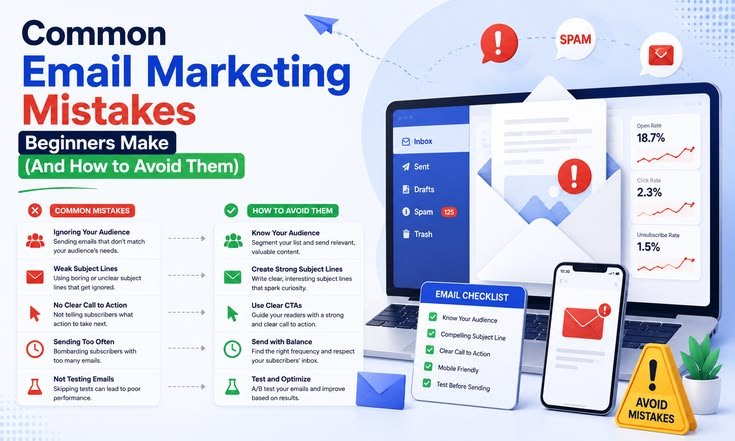
How to Avoid Common Email Marketing Mistakes
Creating better email campaigns starts with a simple process.
First, build a permission-based email list.
Second, understand your target audience.
Third, segment subscribers where appropriate.
Fourth, provide valuable and relevant content.
Fifth, write clear subject lines and calls to action.
Sixth, make emails easy to read on mobile devices.
Seventh, test emails before sending them.
Finally, measure meaningful results and use the information to improve future campaigns.
The goal should not be to send more emails. The goal should be to send better emails.
Conclusion
Email marketing mistakes can reduce engagement, damage trust, and limit business growth. Problems such as buying email lists, sending excessive messages, ignoring mobile users, using misleading subject lines, providing little value, and failing to analyze performance are common but avoidable.
Successful email marketing is based on permission, relevance, consistency, value, and trust.
Businesses should focus on building quality email lists, understanding subscribers, creating useful content, segmenting audiences, testing campaigns, monitoring performance, and respecting subscriber preferences.
Email marketing works best when it is treated as a relationship-building channel rather than simply an advertising tool.
By avoiding common mistakes and continuously improving campaigns, businesses can create better subscriber experiences, increase engagement, strengthen customer relationships, and build a more effective long-term digital marketing strategy.