Email Marketing Strategies That Drive Engagement
Email marketing remains one of the most useful tools for businesses that want to build relationships with customers, generate leads, promote products, and maintain regular communication with their audiences. However, simply sending emails does not guarantee that people will read them, click links, or take action.
Successful email marketing requires a strategy focused on relevance, value, timing, personalization, and continuous improvement. Businesses need to understand what subscribers want and create emails that are useful enough to earn attention.
In this article, we explore practical email marketing strategies that can help businesses increase engagement and build stronger relationships with their subscribers.
What Is Email Engagement?
Email engagement refers to how subscribers interact with the emails they receive.
Engagement can include:
- Opening an email
- Clicking a link
- Reading an article
- Watching a video
- Downloading a resource
- Completing a form
- Making a purchase
- Replying to an email
The exact engagement goal depends on the purpose of the campaign.
For example, a newsletter may aim to generate website visits, while a promotional campaign may focus on purchases.
Understanding the desired action helps businesses create better emails.
1. Understand Your Audience
The foundation of effective email marketing is knowing your audience.
Businesses should understand their subscribers’ interests, needs, challenges, and expectations.
Ask questions such as:
- What problems does my audience want to solve?
- What topics interest them?
- What products or services are relevant to them?
- What type of content do they prefer?
- What questions do they frequently ask?
For example, a website about digital marketing might send subscribers SEO tips, content marketing strategies, social media advice, and online advertising information.
When the content matches subscriber interests, engagement can improve naturally.
2. Segment Your Email List
Sending the exact same message to every subscriber is not always effective.
People join email lists for different reasons and may be at different stages of the customer journey.
Segmentation allows businesses to divide their audience into meaningful groups.
Possible segments include:
- New subscribers
- Existing customers
- Potential customers
- Highly engaged subscribers
- Inactive subscribers
- Product interests
- Geographic regions
- Previous purchases
For example, a new subscriber may need introductory educational content, while an existing customer may benefit from advanced information or related product recommendations.
Relevant communication can create a better subscriber experience.
3. Create Valuable Content
One of the strongest ways to drive engagement is to consistently provide useful information.
Subscribers should have a reason to open your emails.
Useful content can include:
- Educational guides
- Practical tips
- Tutorials
- Industry updates
- Case studies
- Checklists
- Research
- Expert insights
- Helpful resources
A business should avoid making every email a sales pitch.
When subscribers regularly receive useful content, they are more likely to view the business as a valuable source of information.
4. Write Better Subject Lines
The subject line is one of the first things subscribers see.
A strong subject line should clearly communicate the purpose or benefit of the email.
Examples include:
“5 Simple Ways to Improve Your Website”
“Your Guide to Better Email Marketing”
“New Digital Marketing Trends to Know”
“How to Avoid These Common SEO Mistakes”
Subject lines should accurately represent the email.
Avoid misleading or exaggerated claims simply to attract attention.
Trust is more important than a temporary increase in opens.
5. Personalize Your Emails
Personalization can make communication more relevant.
Basic personalization may include using a subscriber’s name.
More advanced personalization can use information such as:
- Previous purchases
- Content interests
- Website behavior
- Customer status
- Product preferences
For example, an online store can recommend products related to a customer’s previous purchases.
A marketing website might send different content to beginners and experienced marketers.
Personalization works best when it provides genuine relevance.
6. Use a Conversational Tone
Emails often perform better when they feel like communication rather than corporate announcements.
A conversational tone can make messages more approachable.
Instead of using unnecessarily complicated language, businesses can write clearly and naturally.
For example, rather than saying:
“Our organization is pleased to announce the availability of a newly developed resource.”
A simpler approach could be:
“We’ve created a new guide to help you improve your online marketing.”
Clear communication is easier to understand and often feels more personal.
7. Use Strong Calls to Action
A call to action tells the subscriber what to do next.
Examples include:
- Read the full article
- Download the guide
- Visit the website
- Book a consultation
- Shop now
- Learn more
- Watch the video
- Register for the event
The CTA should match the purpose of the email.
If the main goal is to encourage readers to download a guide, that action should be easy to find.
Avoid giving subscribers too many competing choices.
8. Keep Emails Easy to Read
Many people scan emails quickly.
Large blocks of text can make messages difficult to understand.
Use:
- Short paragraphs
- Headings
- Bullet points
- Clear spacing
- Simple language
- Relevant images
- Prominent buttons
The main idea should be easy to identify.
If an email contains a large amount of information, consider linking to a detailed article on the website.
9. Optimize Emails for Mobile Devices
A significant portion of email activity happens on mobile devices.
An email that looks excellent on a desktop computer may become difficult to read on a smartphone.
Businesses should use responsive email designs and test their campaigns on different screen sizes.
Important elements include:
- Readable text
- Large enough buttons
- Proper spacing
- Optimized images
- Simple layouts
Mobile optimization can improve the overall subscriber experience.
10. Use Storytelling
Stories can make emails more engaging.
Instead of simply describing a product, businesses can explain the problem that led to its creation or tell the story of how a customer used it.
Stories can be used to communicate:
- Customer experiences
- Business journeys
- Lessons learned
- Product development
- Success stories
- Industry challenges
Good storytelling helps subscribers connect emotionally with the subject.
11. Share Customer Success Stories
Customer stories provide useful social proof.
A good case study can explain:
- The customer’s challenge
- The solution
- The implementation
- The result
For example, a marketing agency might share how a client improved its website traffic after implementing a specific strategy.
Real experiences can make marketing messages more credible.
Businesses should obtain appropriate permission before sharing identifiable customer information or testimonials.
12. Create Automated Email Sequences
Automation allows businesses to send relevant messages based on subscriber actions.
Common automated sequences include:
Welcome Series
Introduces new subscribers to the business.
Educational Series
Provides several lessons about a specific topic.
Abandoned Cart Series
Reminds customers about products they left in their shopping cart.
Post-Purchase Series
Provides information after a purchase.
Re-Engagement Series
Attempts to reconnect with inactive subscribers.
Automation can save time and provide timely communication.
13. Use Behavioral Triggers
Email campaigns can become more relevant when they respond to subscriber behavior.
For example, a subscriber who downloads an SEO guide could receive additional SEO resources.
Someone who purchases a product could receive instructions about using it.
Behavior-based emails can feel more relevant because they respond to what subscribers have actually done.
14. Send Emails at Appropriate Times
Timing can influence engagement.
There is no single sending time that works perfectly for every business.
The ideal schedule depends on:
- Audience location
- Industry
- Subscriber habits
- Type of email
- Business model
Businesses should test different sending times and use their own performance data.
Instead of relying entirely on general advice, look at when your specific audience tends to interact with emails.
15. Maintain a Consistent Sending Schedule
Consistency helps subscribers know what to expect.
For example, a business might send a newsletter every Tuesday or every Friday.
The exact frequency depends on the audience and content.
The goal is to maintain communication without overwhelming subscribers.
A consistent schedule can also make content planning easier for the marketing team.
16. Ask Questions
Email can be used to encourage two-way communication.
Businesses can ask subscribers questions about their interests, experiences, and challenges.
For example:
“What is your biggest challenge with digital marketing?”
“Which topic would you like us to cover next?”
“What type of content do you find most useful?”
Questions can encourage replies and provide valuable customer insights.
17. Use Surveys
Surveys can help businesses understand their audiences more deeply.
A short survey can ask subscribers about:
- Content preferences
- Product interests
- Customer satisfaction
- Common challenges
- Future needs
Businesses can then use the information to improve products and marketing campaigns.
Surveys should be reasonably short and easy to complete.
18. Offer Exclusive Content
Subscribers may be more engaged when they receive information that is not available everywhere else.
Exclusive content might include:
- Special reports
- Subscriber-only tutorials
- Early announcements
- Private resources
- Special promotions
- Early access to products
The goal is to give subscribers a meaningful reason to remain connected.
19. Use Re-Engagement Campaigns
Not every subscriber remains active forever.
Some people stop opening emails because their interests change, they become busy, or they simply receive too many messages.
A re-engagement campaign can attempt to reconnect with inactive subscribers.
For example:
“We haven’t heard from you recently. Would you like to continue receiving our updates?”
You can also invite subscribers to update their preferences.
If someone remains consistently inactive, businesses should follow appropriate list-management practices rather than continuing to send unwanted messages indefinitely.
20. Test Different Subject Lines
Testing can reveal which communication styles appeal most to your audience.
Businesses can experiment with different subject line approaches.
For example:
Benefit-focused:
“Learn 5 Ways to Improve Your Email Results”
Question-based:
“Is Your Email Marketing Working?”
Direct:
“Your New Marketing Guide Is Ready”
The best approach depends on the audience and context.
21. Test Calls to Action
Small changes to CTA wording can sometimes influence behavior.
Compare:
“Click Here”
with:
“Get the Free Guide”
The second option explains what the subscriber will receive.
Calls to action should communicate a clear benefit whenever possible.
22. Use Relevant Visual Content
Images, graphics, and videos can make emails more visually appealing.
However, visuals should support the message rather than distract from it.
A product email might include a product image.
An educational email might include an infographic.
A company update might include a relevant photograph.
Use visuals strategically and ensure important information is still available as text.
23. Connect Email With Your Website
Email marketing should work together with your website.
A newsletter can direct subscribers to:
- Blog articles
- Product pages
- Landing pages
- Tutorials
- Case studies
- Online stores
The website should provide a smooth experience that matches the message in the email.
For example, if an email promotes a specific guide, the landing page should clearly explain and provide access to that guide.
24. Monitor Performance
Email marketing should be measured regularly.
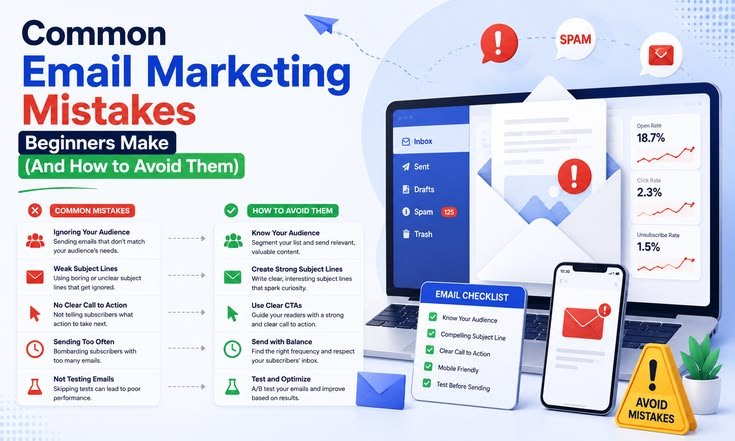
Important metrics include:
- Delivery rate
- Open rate
- Click-through rate
- Conversion rate
- Unsubscribe rate
- Revenue
Each metric provides different information.
A high click rate with a low conversion rate might suggest that the email is effective at generating interest but that the landing page or offer needs improvement.
25. Improve Based on Data
The purpose of analytics is not simply to produce reports.
Businesses should use the information to improve future campaigns.
If educational content performs well, create more educational content.
If a particular topic generates clicks, explore related subjects.
If certain emails produce high unsubscribe rates, review their content, frequency, and targeting.
Continuous improvement can make email marketing more effective over time.
26. Avoid Overloading Subscribers
More emails do not automatically mean more engagement.
Sending too frequently can lead to:
- Unsubscribes
- Lower engagement
- Complaints
- Email fatigue
Businesses should find a frequency that works for their specific audience.
Subscriber preferences and engagement data can provide useful guidance.
27. Respect Subscriber Preferences
Subscribers should have reasonable control over their communication.
Businesses can provide options such as:
- Changing email frequency
- Selecting preferred topics
- Updating personal information
- Unsubscribing
Respecting preferences can improve trust and create a better customer experience.
Conclusion
Email marketing engagement is built through relevance, value, consistency, and trust.
Businesses can improve engagement by understanding their audience, segmenting subscribers, creating useful content, writing strong subject lines, personalizing messages, optimizing emails for mobile devices, and using clear calls to action.
Automation and behavioral triggers can deliver timely communication, while surveys and questions can create two-way conversations.
Testing and analytics are equally important. Businesses should monitor performance, learn from subscriber behavior, and continuously improve their campaigns.
The most successful email marketing strategies do not focus simply on sending more messages. They focus on sending better messages to the right people at the right time.
When businesses consistently respect their subscribers and provide useful information, email can become a powerful channel for building relationships, increasing engagement, generating leads, and supporting long-term growth.